A custom app is a complete, self-contained website that you package as a .zip file
and play on your screens like any other media. Everything is stored on the device, so the
app keeps playing when the internet drops. Custom apps were previously called Offline HTML.
EasySignage hands every custom app a set of player attributes: the identity and context of the screen it is running on, including the player ID, the screen name, the screen or display-unit ID, the resolution, the location, and your custom tags. Your app reads those values and changes what it shows, so one package behaves differently on every screen. The attributes also use Broadsign-compatible key names, so a creative migrated from Broadsign can keep its field names.
With custom apps you can:
- Show the right content per screen, per store, zone, floor, region, or language
- Personalise API and data requests using the screen’s ID or tags
- Keep playing reliably offline, with no server round-trip on every frame
- Reuse one package across hundreds of screens instead of building one for each
New to this? You do not need to write code to try it. Download the ready-made sample package and upload it, and the page displays every value your screen delivered. Developers can then copy one file into their own project to read the same values.
Download the sample
To see how custom apps work, run the sample package. It shows every attribute the device delivered, live on the screen.
Ready-made custom app sample
Download sample.zip
The .zip contains three files:
| File | What it is |
|---|---|
index.html | The page itself, and always the entry point. Markup only. |
easysignage.js | The small, reusable reader you copy into your own project to get the player attributes. |
demo.js | Throwaway code that draws the values on screen for the sample. Ignore it in real projects. |
Required: the entry point of every custom app must be named
index.htmland sit at the top level of the.zip. Keep all assets, images, CSS, JS, and fonts, inside the same package and reference them with relative paths so the app works with no internet connection.
More ready-made apps
Our free, open-source Digital Signage Custom Apps toolkit on GitHub has more apps you can upload as they are, or change to suit you:
| App | What it shows | Tags it reads | Download |
|---|---|---|---|
| Player info | Every attribute the screen sends (the same as the sample above). Use it to check a screen. | all | player-info.zip |
| Clock | Full-screen clock and date, fully offline | clock_format, greeting, theme, accent | clock.zip |
| Countdown | Countdown to an event set per screen | event_name, event_date, done_text, theme, accent | countdown.zip |
| Menu board | Menu from a data file, chosen per screen | menu, special, theme | menu-board.zip |
| Zone promo | A different promotion and image per store zone | zone, accent | zone-promo.zip |
| Starter | A minimal template to build your own app | zone, theme, accent | starter.zip |
Quick start without coding
Upload the
.zipin one of two ways:- In a playlist: open the playlist, click the layer, click Add New > Upload media, and choose the
.zip. It is added to the layer straight away. See Upload Media . - In Media Assets: go to Media Assets, click Add Media > Upload Media Assets, and choose the
.zip. Then add it to a playlist with Add New > Media Assets. See Media Assets .
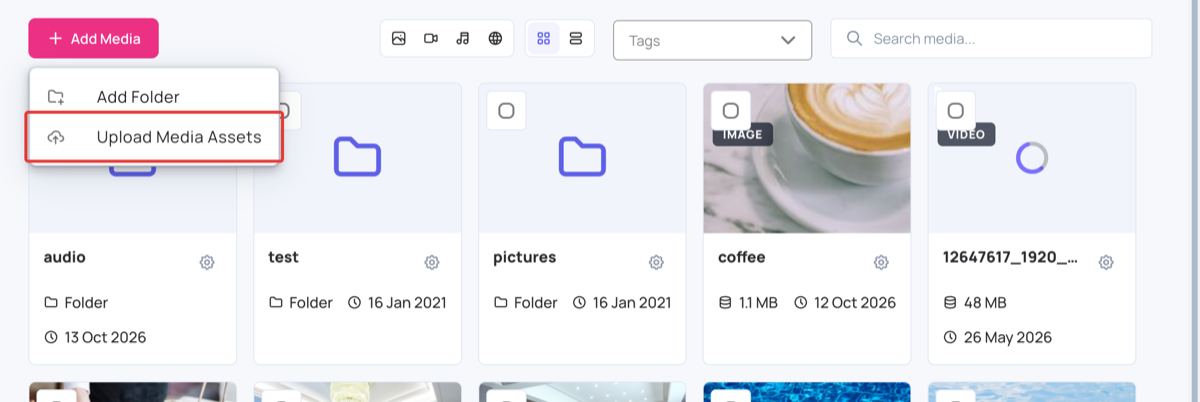
- In a playlist: open the playlist, click the layer, click Add New > Upload media, and choose the
Click Publish changes of this playlist, and assign the playlist to a screen.
The app appears in the layer. In the CMS the preview shows empty values, because only a screen sends its attributes.
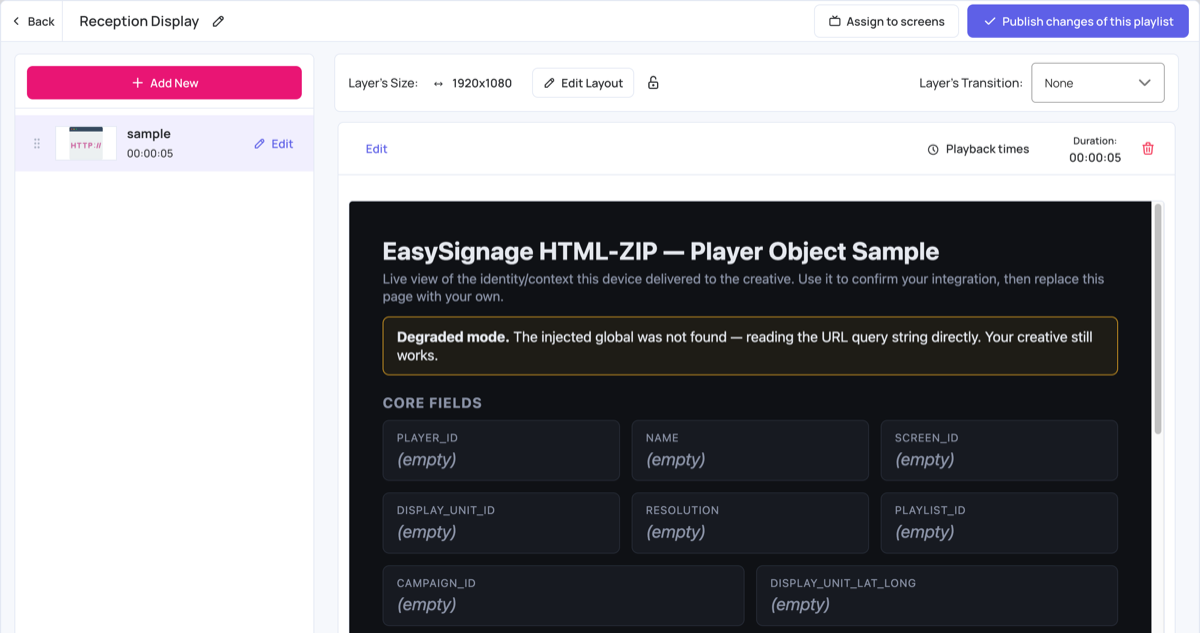
The sample page appears on the screen and lists every attribute the screen sent, with a banner that shows which delivery channel is active. That confirms the integration works end to end.
Give each screen its tags
Apps that show different content per screen read the screen’s tags. Add tags as
key:value, for example zone:north or menu:lunch: open the screen, click More >
Tags, type each tag and press Enter, then click Save. See
Screen actions
, or
tag several screens at once
.
Only tags written as
key:valuereach your app as named values (tags.zone). A tag without a colon, such aslobby, is only included intags.all.
Build a custom app with AI
You can build a custom app without writing code: describe the screen you want to an AI tool, and it writes the app for you. The free Digital Signage Custom Apps toolkit gives the AI the rules that signage screens need, such as working offline, running on older players, reading tags and keeping secrets out of the code, so what it builds plays on real screens.
For a longer walk-through with example prompts, see our blog post How to Build a Custom Digital Signage App with AI .
Step 1: Connect the toolkit to your AI tool
| AI tool | How to set it up |
|---|---|
| Claude Code | Run /plugin marketplace add easysignage/Digital-Signage-Custom-Apps, then /plugin install easysignage-custom-apps@easysignage. It then works in every project. |
| Claude.ai (web, desktop, mobile) | Download the skill zip , then go to Settings > Capabilities > Skills > Upload skill. Code execution must be on. |
| Codex, Cursor, GitHub Copilot | Clone or download the repository
and open its folder. These tools read its AGENTS.md file automatically. |
| ChatGPT and other chat assistants | Paste or upload SKILL.md
and easysignage.js
into the chat. |
Step 2: Describe the screen
Say what the screen shows, its orientation, what changes per screen (these become tags), your brand colours and logo, and where the content comes from. For example:
Build an EasySignage menu board for my cafe with breakfast and lunch menus chosen per screen by a
menutag. Works in portrait and landscape. Package it as a zip and tell me which tags to set on each screen.
A coding agent creates the files for you. With a chat assistant, save the files it gives you into one folder.
Step 3: Preview in your browser
Open the app’s index.html in a browser and add test values to the address to see what a
screen would show:
index.html?name=Lobby&resolution=1920x1080&tags.menu=lunch
Change the values and reload to check each version. Ask the AI for any changes, for example “make the prices bigger”.
Step 4: Check and package it
With a coding agent in the toolkit folder, ask it to “check and package the app”. It runs the
toolkit’s checks for the problems that break apps on signage players, then creates a .zip
in the dist folder with index.html at the top level. You can also run it yourself:
./scripts/package.sh my-app
With a chat assistant, zip the contents of the app folder, not the folder itself.
Step 5: Upload it and set the tags
Upload the .zip and add it to a playlist as in the quick start
,
then give each screen the tags the AI listed.
Review what the AI built. Check the text on screen carefully and test on one screen of each player model before you roll it out. Never give the AI real API keys or passwords to put in the app: the app is copied onto every screen.
Build it yourself from the starter
If you prefer to code it yourself, start from the toolkit’s starter template:
git clone https://github.com/easysignage/Digital-Signage-Custom-Apps.git
cd Digital-Signage-Custom-Apps
cp -R templates/starter my-app       # 1. copy the starter
                                     # 2. edit my-app/app.js and style.css
./scripts/package.sh my-app          # 3. check and zip it -> dist/my-app.zip
The toolkit’s getting started guide covers each step.
How the data reaches your app
EasySignage delivers the same player attributes through two channels, so your app keeps working no matter how the creative is built or secured:
You don't choose a channel, easysignage.js reads whichever is available.
1. A global JavaScript object
EasySignage injects a small script into your index.html that defines a global object
before any of your own scripts run:
window.easysignage // the player object, e.g. { player_id: "...", tags: { zone: "north" }, ... }
2. A URL query string
The same values are also appended to the page URL on every render:
index.html?player_id=PL-abc123&name=Main%20Lobby&display_unit_id=SC-9&tags.zone=north&...
The query string is always present. If a strict security policy on your creative blocks
the injected script and the global is missing, your app still reads the values from the URL.
Keys that start with tags. (for example tags.zone) rebuild into a tags object.
You normally don’t choose between them. The
easysignage.jsreader uses the global when it is available and falls back to the URL automatically. You call one function.
For developers: read the attributes
Copy easysignage.js from the sample into your project and load it with a plain script
tag before your own code:
<!-- index.html -->
<script src="easysignage.js"></script>
<script>
  var panel = EasySignage.read();          // the player object (global or URL — handled for you)

  var playerId = panel.player_id || "";
  var screen   = panel.name || "";
  var zone     = (panel.tags && panel.tags.zone) || "";

  // ...use these values to drive your creative.
</script>
That is the whole integration. EasySignage.read() returns the player object. You can also
read window.easysignage directly.
Migrating from Broadsign:
EasySignage uses the same Broadsign key names
(display_unit_id, display_unit_resolution, frame_resolution, campaign_id,
display_unit_lat_long), so your field names carry over. Read them from the EasySignage
player object:
var panelVariables = EasySignage.read();
if (panelVariables) {
  this.playerId  = panelVariables.player_id || "";
  this.screenId  = panelVariables.display_unit_id || "";
  this.latLong   = panelVariables.display_unit_lat_long || "";
}
Warning:
window.BroadSignObjectwas removed. A creative that reads that global no longer receives player attributes. Update it to useEasySignage.read()orwindow.easysignage.
Load
easysignage.jsas a classic script (<script src="...">), not astype="module". A classic external script also runs under a strictContent-Security-Policy(script-src 'self') that would block inline scripts, and it works on older Tizen, webOS, and BrightSign webviews underfile://.
Available attributes
EasySignage delivers a focused, Broadsign-compatible set of attributes. The same value is exposed under both the native EasySignage key and its Broadsign alias, so a creative written for either platform can keep its field names.
Values are strings and are normally present as "" when unknown. The one exception is
display_unit_lat_long, which is present only when the device’s location is known.
| Native attribute | Broadsign alias | Description |
|---|---|---|
player_id | player_id | Unique player ID (GUID). Same key name as Broadsign. |
name | — | Display name of the player or screen. |
screen_id | display_unit_id | Screen (display unit) identifier. |
resolution | display_unit_resolution, frame_resolution | Screen resolution, for example 1920x1080. |
playlist_id | campaign_id | ID of the playlist this content is playing in (Broadsign’s nearest concept is the campaign). |
| — | display_unit_lat_long | Device location as a single "lat,long" string. Present only when the location is known. |
tags | — | Your custom labels as { key: value }. See Tags
. |
Data minimisation:
Custom apps are third-party code, so EasySignage exposes only the fields in the preceding table. Device identifiers (serial, device ID), OS, manufacturer and version details, precise separate coordinates, orientation, and the playlist and media names are not passed to your app.
Tags
Tags are the custom key:value labels you assign to your screens, for example zone:north,
store:42, or lang:ar. Use them to drive your own business logic. They arrive as an
object, plus a joined string:
var panel = EasySignage.read();

panel.tags.zone;     // "north"
panel.tags.store;    // "42"
panel.tags.all;      // "zone:north,store:42"   (comma-separated, key:value)
Tags are case-sensitive; prefer lowercase keys. Up to 20 tags are carried to the device. The complete set always exists in your EasySignage account.
Value rules
Every delivered field is a string.
Unknown values are present as an empty string
"". The key is never missing, so you can readpanel.namewithout checking that it exists first. The one exception isdisplay_unit_lat_long, which is present only when the device location is known.tagsis always an object, possibly empty.tags.allis the comma-separated string.Keep the package self-contained and use relative paths so it runs fully offline.
Example: show different content per screen
<script src="easysignage.js"></script>
<script>
  var panel = EasySignage.read();
  var zone  = (panel.tags && panel.tags.zone) || "default";

  // pick content based on the screen's zone tag
  var banners = {
    north: "north-promo.jpg",
    south: "south-promo.jpg",
    default: "generic-promo.jpg",
  };
  document.getElementById("hero").src = banners[zone] || banners.default;

  // rotate the layout for portrait screens (resolution is "WIDTHxHEIGHT")
  var res = (panel.resolution || "").split("x");
  if (res.length === 2 && Number(res[1]) > Number(res[0])) {
    document.body.classList.add("portrait");
  }
</script>
Troubleshooting
Nothing shows up: Confirm the entry file is named
index.htmland sits at the top level of the.zip, and that every asset uses a relative path.The injected global is missing: A strict
Content-Security-Policyin your page can block the injected script. Use theeasysignage.jsreader, or read the URL query string, and your app still gets the values.The app fails on older devices: Keep your scripts as classic scripts, with no
type="module", so they run on older Tizen, webOS, and BrightSign webviews.A tag doesn’t work: Upload player-info.zip to the screen to see every value it sends. Tag names are case-sensitive, and only
key:valuetags arrive as named values.Test locally first: Open
index.htmlin a browser with a query string appended, for exampleindex.html?player_id=TEST&display_unit_id=SC-1&resolution=1080x1920&tags.zone=north, to preview how your app reacts before you upload it.
Related articles
- Website Dynamic URL Variables : pass the same player attributes into an online URL.
- Upload Media : how to add media to EasySignage.
- Screens : how to add tags to a screen.
- Digital Signage Custom Apps toolkit : examples, the starter template and AI agent skills on GitHub.
- How to Build a Custom Digital Signage App with AI : a step-by-step guide with example prompts.