What Is AI Digital Signage? How Smart Screens Are Replacing Static Displays
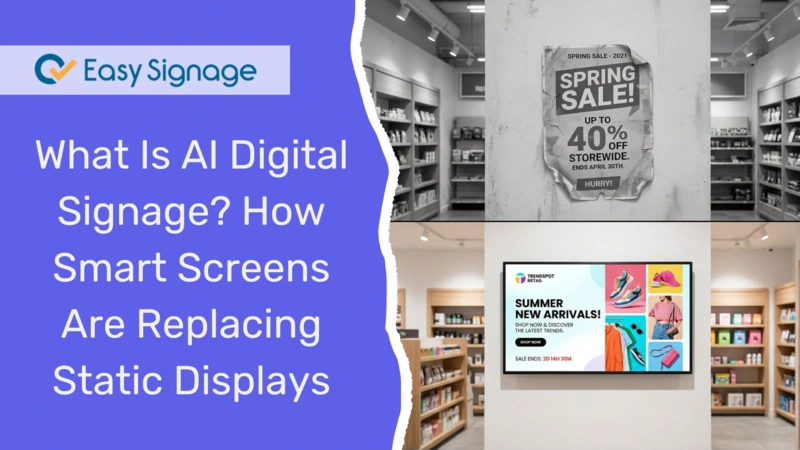
AI digital signage is a system that uses artificial intelligence to automatically decide what content to show, when to show it, and who to show it to, all without manual effort. Instead of playing the same content on a loop, AI-powered screens react to real-world data like time, location, and audience demographics to display the most relevant message at the right moment.
If you are still using static posters or looping playlists that never change, you are already behind. In 2026, businesses across retail, hospitality, healthcare, education, and corporate offices are switching to AI-powered screens that think, adapt, and deliver results.
This guide explains what AI digital signage is, how it works, why it outperforms static displays, and how you can start using it today.
What Is AI Digital Signage?
AI digital signage combines digital screens with artificial intelligence software to create displays that automatically adapt their content based on real-time data.
Traditional digital signage shows pre-scheduled content on a fixed loop. You upload images or videos, set a playlist, and the screen plays the same thing all day. It is better than a printed poster, but it is still a one-size-fits-all approach.
AI digital signage takes this further. It uses data inputs, such as who is watching, what time it is, or what is trending, to automatically change what appears on screen.
Here is a simple comparison:
Static display: A printed poster promoting winter jackets stays up all season, even on a warm day.
Traditional digital signage: A screen loops through jacket ads, shoe ads, and accessory ads all day in the same order.
AI digital signage: The screen on a rainy afternoon notices young adults nearby, and automatically shows a rain jacket promotion with a limited-time discount; no human input needed.
In short, AI digital signage makes your screens smarter, faster, and more relevant.
How Does AI Digital Signage Work?
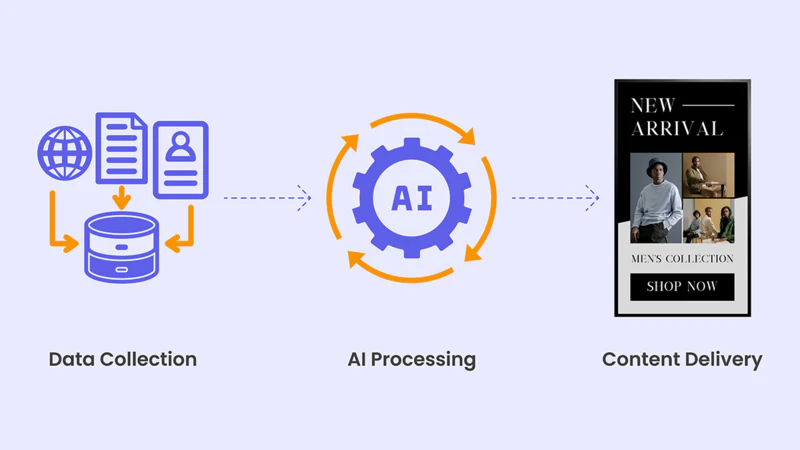
AI digital signage works by connecting your screens to intelligent software that collects and processes data in real time. Here is how the process works, step by step:
1. Data Collection
The system gathers information from different sources. These can include:
Audience data: Anonymous cameras or sensors detect who is in front of the screen, age group, gender, and how long they look at it (called dwell time).
Time and date: The system knows whether it is morning, afternoon, or night, and adjusts content accordingly.
Location data: If you manage multiple locations, the system can automatically display location-specific content.
2. AI Processing
Once the data is collected, AI algorithms analyse it and decide what content is most relevant. This happens automatically and in real time. There is no need for someone to sit behind a computer and manually update playlists every hour.
3. Content Delivery
The system pushes the selected content to the screen. This could be a specific promotion, a video, an announcement, or a combination of media, all tailored to the current context.
4. Learning and Optimising
The best AI signage systems learn over time. They track which content gets the most attention, which promotions lead to action, and which time slots perform best. This data feeds back into the system, making future content decisions even smarter.
Why Are Smart Screens Replacing Static Displays?
Static displays, whether printed signs or basic digital screens with fixed playlists, have clear limitations. Here is why businesses are making the switch to AI-powered alternatives.
Static Displays Are Easy to Ignore
People walk past the same poster or looping screen dozens of times. After a while, it becomes invisible. Research shows that dynamic, changing content captures significantly more attention than static images. When a screen reacts to its environment, showing something new and relevant, it naturally draws the eye.
Manual Updates Are Slow and Costly
With static signage, every change requires effort. You either reprint materials or log into your system and manually swap content. For businesses with multiple locations, this becomes a major time drain. AI digital signage eliminates this bottleneck. Content updates happen automatically based on the rules and triggers you set up once.
One Message Cannot Speak to Everyone
A single printed sign or a fixed playlist treats every viewer the same way. But your audience changes throughout the day. Morning customers have different needs from evening visitors. A young professional browsing during lunch has different interests than a family shopping on a weekend. AI-powered screens adapt to these differences automatically.
You Cannot Measure What a Poster Does
With printed signs and basic digital screens, you have no way to know if anyone looked at your message, how long they paid attention, or whether it influenced a purchase. AI digital signage gives you real data, impressions, dwell time, audience demographics, and even content performance metrics. You can see what works and improve it.
Speed Matters More Than Ever
Markets move fast. A promotion that is relevant today might not be relevant tomorrow. Static displays cannot keep up. AI-powered screens respond to change instantly, keeping your messaging fresh and timely without manual intervention.
Key Features of AI Digital Signage
Not all AI digital signage systems offer the same features. Here are the capabilities that make the biggest difference for businesses:
Audience Targeting
AI cameras can detect anonymous demographic information about the people in front of your screen, such as estimated age group and gender, and display content tailored to them. No personal data is stored; the system processes everything locally and in real time.
For example, EasySignage offers an Audience Targeting feature that allows businesses to automate content delivery by showing the right message to the right audience at the right time.
Automated Content Scheduling
Instead of manually setting playlists, AI systems schedule content based on rules you define. You can set a breakfast menu to show in the morning, lunch specials at midday, and happy hour deals in the evening, all automatically.
EasySignage supports scheduled content that changes based on time of day, day of week, or specific dates, reducing manual work and keeping screens always relevant.
Geolocation-Based Content
AI digital signage can use the physical location of each screen to deliver location-specific content automatically. Instead of pushing the same message to every screen in your network, you can set virtual zones so each location displays content relevant to its area; different promotions for different cities, regions, or even different floors of the same building.
EasySignage offers a Geolocation feature that lets businesses define virtual zones and deliver location-specific content to screens within those zones. This is especially useful for multi-location businesses like retail chains, restaurant franchises, and corporate offices with screens spread across different sites.
Context-Aware Messaging
Context-aware displays adjust content based on external triggers like weather, local events, or even inventory levels. If a product sells out, the screen automatically stops promoting it and switches to an alternative. If it starts raining, the screen shows weather-appropriate products.
Real-Time Analytics
AI digital signage systems track how your content performs. You can see which messages get the most views, how long people watch, and what drives action. This data helps you improve your strategy over time.
EasySignage provides audience analytics that give businesses actionable insights into who is watching and how content is performing.
Cloud-Based Management
Modern AI digital signage runs on the cloud. This means you can manage all your screens from one dashboard, whether you have 1 screen or 1,000 screens across different locations. You can update, schedule, and monitor everything remotely.
With cloud-based digital signage platforms like EasySignage, there is no need for on-site servers or IT teams at every location.
Real-World Use Cases
AI digital signage is not a future concept. Businesses are already using it across many industries. Here are practical examples:
Retail Stores
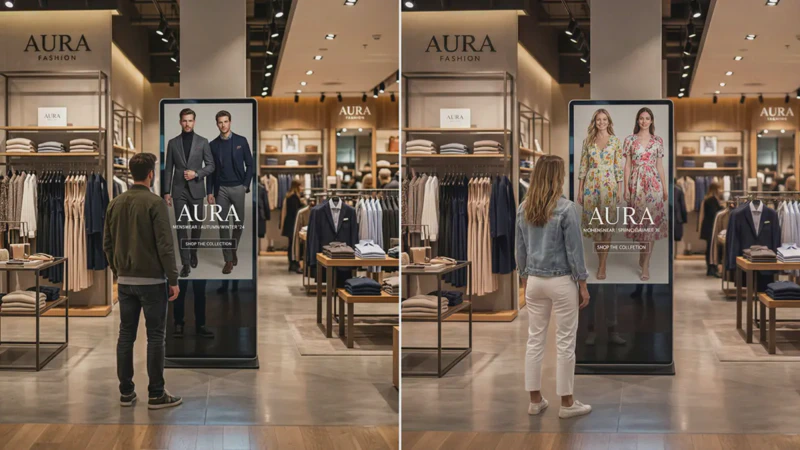
A clothing store uses AI-powered screens to display winter coat promotions when the temperature drops below 10°C. When the store detects mostly female shoppers in the afternoon, it highlights the women’s collection. During a flash sale, screens update instantly across all locations.
Quick-Service Restaurants
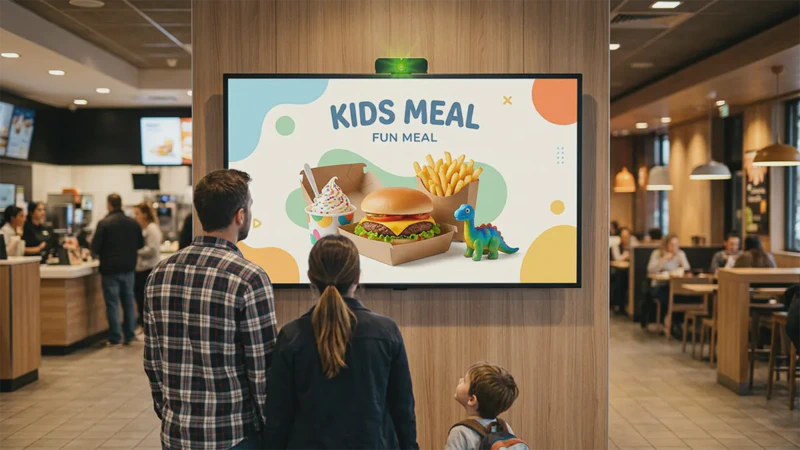
A fast-food chain uses AI to switch digital menu boards from breakfast to lunch to dinner menus automatically at the right time, no staff intervention needed. When the screen detects a family with kids approaching, it highlights kids’ meals, fun combos, and dessert options to grab their attention.
During peak hours, the menu shifts focus to quick-serve items and meal deals to speed up ordering. Menu prices, descriptions, and visuals update instantly across all locations from one dashboard.
Corporate Offices
An office lobby screen displays company branding and welcome messages for visitors. Meeting room displays show real-time schedules using Google Slides or data dashboards integrated directly into EasySignage.
Internal communication screens show company news and KPIs in the morning, wellness tips during lunch breaks, and shift updates in the afternoon, all scheduled automatically from one dashboard.
Healthcare
A hospital uses digital screens to display estimated wait times, direct patients to the right department with wayfinding maps, and show health tips in waiting rooms. Content changes automatically based on the time of day and which departments are busiest.
Education
A university campus uses AI screens to promote events, display cafeteria menus during meal times, and show emergency alerts when triggered. The system adjusts content by building; different screens in the library, sports centre, and student union, showing different content at the same time.
How to Get Started with AI Digital Signage
Getting started does not require a massive budget or a technical team. Here is a simple path:
Step 1: Choose a Screen
You can use a commercial display, a Smart TV, or even a regular TV with a media player connected to it. EasySignage works with Android TVs, Samsung, LG, BrightSign, Raspberry Pi, Amazon Fire TV Stick, and more.
Step 2: Add an AI Camera
If you want advanced features like audience targeting and demographic analytics , you will need a camera connected to an AI-powered device. EasySignage uses an AI-powered audience analytics solution for face detection and demographics. It provides real-time insights on footfall, audience demographics, and engagement.
Here are the recommended specs:
- Camera: 1080p (Full HD) resolution, minimum 10 frames per second (FPS).
- AI Device: RK3588 edge AI processor or equivalent (octa-core, 8nm), minimum 8 GB RAM, 64 GB storage, 6 TOPS NPU (Neural Processing Unit), Android 13+ (64-bit).
If your device has a built-in camera, it will be auto-detected. For USB cameras, simply connect them before installation. Once set up, EasySignage AI works as a standalone analytics tool or integrates directly with your EasySignage digital signage system for AI-powered content delivery.
Step 3: Pick a Cloud-Based CMS
Your content management system (CMS) is the brain of your digital signage. Choose a platform that supports AI features like audience targeting , automated scheduling , and analytics . EasySignage offers all of these in one cloud-based platform.
Step 4: Set Up Your Content
Create your first playlist using templates, images, videos, or apps. EasySignage integrates with Canva so you can design professional content without needing a graphic designer.
Step 5: Define Your Rules
Set up your content triggers and scheduling rules. For example:
- Show breakfast menu from 6 AM to 11 AM.
- Target specific demographics with audience-aware content.
Step 6: Publish and Monitor
Hit publish, and your content goes live on your screens. Use the analytics dashboard to track performance and refine your strategy over time.
Frequently Asked Questions
Is AI digital signage expensive?
Not necessarily. You can start with a Smart TV you already own and a free digital signage platform like EasySignage, which offers a free plan for one screen. AI features like audience targeting and scheduling are included in affordable plans.
Do I need cameras for AI digital signage?
Cameras are optional. They enable advanced features like audience targeting and dwell time analytics, but many AI features, like automated scheduling, work without any cameras.
Is audience data private?
Yes. Modern AI signage systems process audience data anonymously and locally. No personal information is stored or transmitted. The system only detects general demographics like estimated age group and gender, not individual identities.
Can I use AI digital signage with my existing screens?
In most cases, yes. If your screen supports a media player (via HDMI) or runs a compatible operating system like Android, Tizen, or WebOS, you can install digital signage software on it. Check the EasySignage supported devices page for a full list.
How is AI digital signage different from regular digital signage?
Regular digital signage plays content on a fixed schedule. AI digital signage automatically adapts what is shown based on real-time data, like audience or time triggers. It requires less manual effort and delivers more relevant content.
The Bottom Line
Static displays had their time. In 2026, they simply cannot keep up with the speed, personalisation, and intelligence that businesses need to stay competitive.
AI digital signage turns your screens into smart, responsive communication tools that adapt to your audience, your environment, and your business goals, automatically.
Whether you are running a retail store, a restaurant, a corporate office, or a school, AI-powered screens help you say the right thing to the right people at the right time.
Ready to make your screens smarter? Start free with EasySignage , no credit card required.